

Praying mantises are predators that mainly eat live insects such as flies, moths, crickets, grasshoppers, and aphids. They are ambush hunters, so they wait motionless and strike fast at anything small enough to grab. Their diet changes as they grow: tiny nymphs start with fruit flies and aphids, while adults can take larger prey like crickets and moths. In this guide, you will learn what praying mantises eat in the wild, what babies eat, and how to feed a pet mantis safely.
Fun fact: the mantis gets its name from its folded front legs, which look like a person in prayer. If that theme interests you, you may like our prayer points for church growth.
What Do Praying Mantis Eat?
A praying mantis is a strict carnivore. Almost everything it eats is a live, moving animal, and it rarely touches dead or still food. Here are the most common prey items:
• Flies and fruit flies
• Moths
• Crickets
• Grasshoppers
• Beetles
• Aphids
• Caterpillars
Common Insects Praying Mantises Eat
Mantises are not fussy. They eat whatever insect comes within reach, as long as it is small enough to hold. Flying insects like flies, moths, and bees are favorite targets, along with soft-bodied insects such as aphids and caterpillars.
Do Praying Mantises Eat Spiders?
Yes. A mantis will eat a spider if one comes close enough to grab. Larger mantises can take on bigger spiders, but a spider’s bite can still be a risk to a small mantis.
Do Praying Mantises Eat Other Praying Mantises?
Yes, cannibalism is common. Mantises will eat each other, especially when hungry or kept together in a small space. This is why captive mantises are usually housed alone.
Can Praying Mantises Eat Small Birds or Frogs?
Occasionally, but it is rare. Very large mantis species have been recorded catching small frogs, lizards, and even hummingbirds. These cases are exceptions and not part of the normal diet.
What Do Praying Mantis Eat in the Wild?
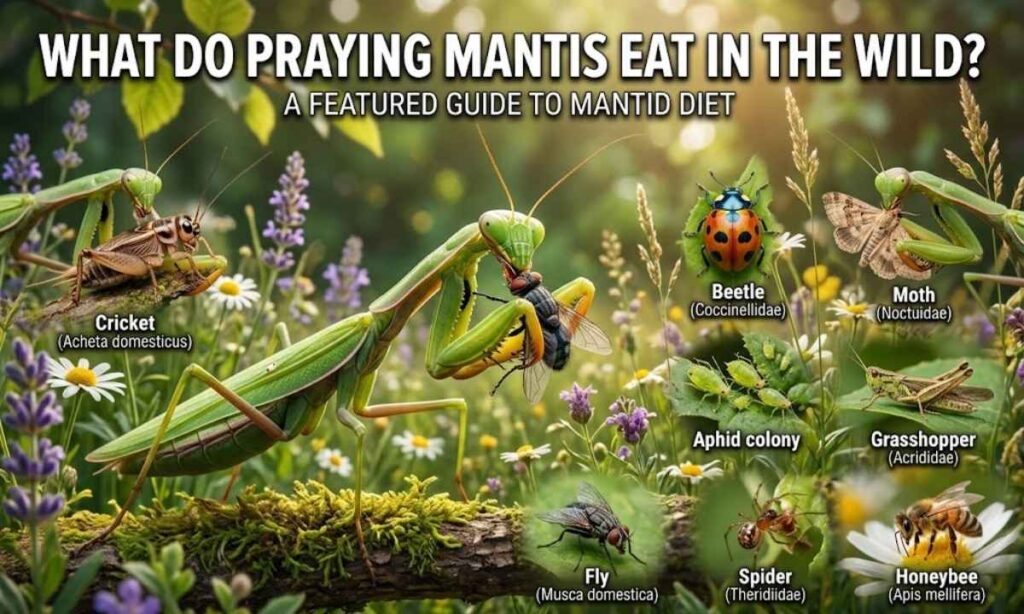
In the wild, a mantis eats whatever insects pass by its hunting spot. Diet depends on the habitat, the season, and the size of the mantis.
How Praying Mantises Find and Catch Their Food
Mantises hunt by sight. They stay still on a leaf or stem, camouflaged, and track movement with their large eyes. When prey comes within range, they snap out their spiked front legs in a fraction of a second and hold the prey while they eat it.
What Do Praying Mantises Eat in Gardens?
In gardens, mantises eat flies, moths, beetles, grasshoppers, caterpillars, and aphids. They stay near flowers, shrubs, and tall grass where insects gather.
Do Praying Mantises Eat Garden Pests?
Yes, they eat many pests, but they are not picky. They will also eat helpful insects like bees and butterflies, so they should not be treated as a perfect pest control method.
| Garden Insect | Eaten by Mantis? | Note |
| Aphids | Yes | Mostly eaten by young nymphs |
| Caterpillars | Yes | Soft-bodied and easy to catch |
| Grasshoppers | Yes | Eaten by larger nymphs and adults |
| Beetles | Yes | Depends on the size of the beetle |
| Bees and butterflies | Yes | Mantises also eat helpful insects |
What Do Baby Praying Mantis Eat?
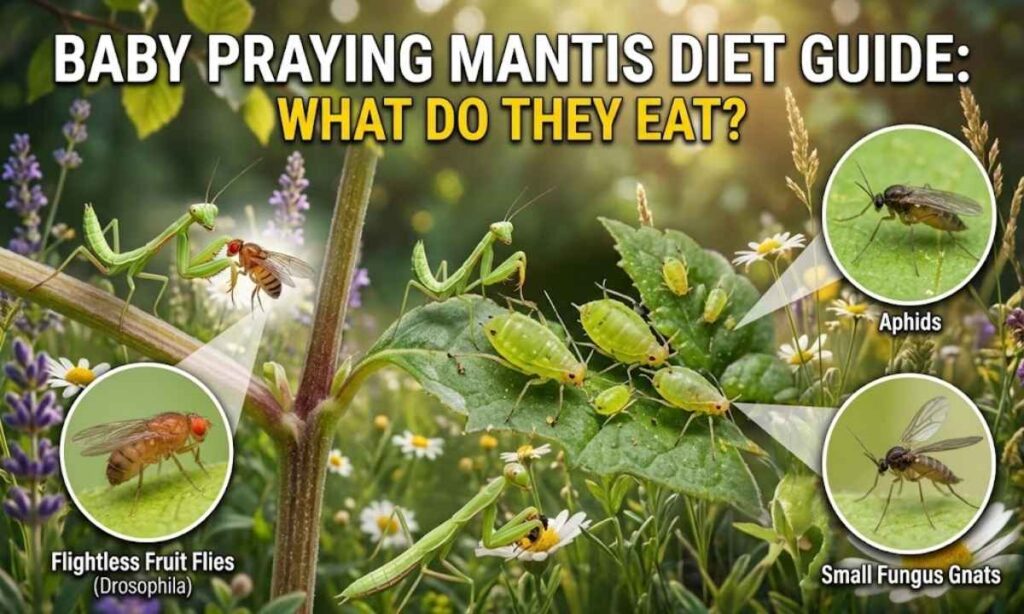
Baby mantises, called nymphs, eat the same kind of food as adults but in much smaller sizes. Tiny nymphs need tiny prey.
What Do Newly Hatched Praying Mantises Eat?
Newly hatched mantises eat fruit flies, aphids, and other very small soft insects. They are born hungry and begin hunting within a short time of hatching.
Do Baby Praying Mantises Eat Fruit Flies?
Yes. Fruit flies are the most common first food for baby mantises, especially in captivity. Wingless fruit flies are easy for tiny nymphs to catch and hold.
When Do Baby Praying Mantises Start Eating?
Most nymphs begin to eat within a day or two after hatching. Some eat their siblings if no other food is available, so it is best to separate them early.
How Does a Baby Mantis Diet Change as It Grows?
As a mantis molts and gets bigger, it can handle larger prey. The table below shows a simple guide.
| Growth Stage | Suitable Prey | Approximate Feeding Frequency |
| Newly hatched nymph | Fruit flies, aphids | Every 1 to 2 days |
| Small nymph | Larger fruit flies, small flies | Every 1 to 2 days |
| Medium nymph | Houseflies, small crickets | Every 2 to 3 days |
| Subadult and adult | Crickets, moths, roaches, large flies | Every 2 to 4 days |
What Do Pet Praying Mantis Eat?
Pet mantises eat live feeder insects. Which ones you choose depends on the size and species of your mantis.
Best Feeder Insects for Pet Praying Mantises
Good options are fruit flies, houseflies, blowflies, small crickets, moths, and roaches such as discoid or dubia nymphs. Feeding a mix of insects is better than using just one kind.
| Feeder Insect | Best For | Note |
| Fruit flies | Newly hatched nymphs | Use flightless types |
| Houseflies and blowflies | Small to medium mantises | Good for active hunters |
| Small crickets | Medium to adult mantises | Remove any left uneaten |
| Moths | Adults | A natural prey item |
| Roach nymphs | Medium to adult mantises | Easy to keep and breed |
How Often Should You Feed a Pet Praying Mantis?
Nymphs usually eat every 1 to 2 days, while adults can eat every 2 to 4 days. Watch the abdomen: if it looks round and full, the mantis can skip a meal.
How Big Should the Food Be?
Prey should be about the size of the mantis’s body or smaller. Prey that is too large can hurt the mantis, so smaller is always safer.
Can You Feed a Praying Mantis Wild-Caught Insects?
It is possible, but risky. Wild insects may carry pesticides or parasites, so captive-bred feeders are the safer choice.
Do Praying Mantises Eat Fruit, Leaves, or Vegetables?
No, not as a normal diet. A praying mantis depends on animal prey, and plants are not part of what it normally eats.
Are Praying Mantises Herbivores or Carnivores?
They are carnivores. Rare reports of mantises nibbling on plant material should not be treated as typical behavior.
Can Praying Mantises Eat Honey or Pollen?
Some mantises may lick a little nectar, honey, or pollen occasionally, and young nymphs have been seen eating pollen when prey is scarce. This is not a replacement for live insects and should not be a main food source.
What Should You Not Feed a Praying Mantis?
Avoid anything that is too big, toxic, or unsafe. The most common mistakes are listed below.
Why Oversized Prey Can Be Dangerous
Large or strong prey can fight back, injure the mantis, or cause problems during molting. Always choose prey that is smaller than the mantis.
Why Pesticide-Exposed Insects Should Be Avoided
Insects from sprayed lawns, gardens, or fields may carry chemicals that poison a mantis. Use clean, captive-bred feeders whenever you can.
Why Uneaten Live Prey Should Be Removed
Live prey left in the enclosure can stress or even bite a mantis, especially a molting one. Take out any uneaten insects after a few hours.
How Much Can a Praying Mantis Eat in One Day?
There is no fixed number, because appetite changes with species, age, temperature, and recent meals. A young nymph may eat several fruit flies in a day, while an adult may eat just one large insect and then wait a few days.
Body size and the fullness of the abdomen are the best guides. A slim, flat abdomen means the mantis is hungry, and a plump abdomen means it is full. Mantises often refuse food before a molt, which is normal.
Frequently Asked Questions
Do praying mantises eat mosquitoes?
Yes, they will eat mosquitoes if they can catch them. However, mosquitoes are small and not a major part of their diet.
Do praying mantises eat ants?
Sometimes, but ants are not a favorite food. Mantises usually prefer softer, juicier insects over ants.
Do praying mantises eat worms?
Not usually, since they hunt moving insects. Soft caterpillars are eaten more often than worms.
Do praying mantises eat butterflies?
Yes. Butterflies and moths are easy targets for a mantis when they land nearby. Mantises can catch them in mid-air or while they rest.
Do praying mantises drink water?
Yes, they drink water droplets from leaves or from light misting. They also get some moisture from the insects they eat.
Can praying mantises survive without food?
For a short time, yes. Adults may survive about one to two weeks without food, while young nymphs are weaker and need food sooner.
Do praying mantises eat their mates?
Sometimes. Females may eat males during or after mating, but it does not happen every time and is more common in captivity.
Conclusion
Praying mantises are carnivores that live mainly on live insects, from tiny fruit flies for babies to crickets and moths for adults. In the wild they eat whatever they can catch, while captive mantises depend on you for safe, clean feeders. Prey size matters most: choose insects the same size as the mantis or smaller, avoid pesticide-exposed bugs, and remove leftovers. With the right food and simple care, a mantis can stay healthy and active.
Related Reading
• Warfare prayer points with scriptures
• Good morning prayer for my love