

The Durga Chalisa is a devotional hymn dedicated to Maa Durga, the Divine Mother who is worshipped as a symbol of strength, courage, and protection. It contains 40 principal verses that praise her forms, her powers, and her victories over evil. In this article, you will find the complete Hindi lyrics, an easy Roman transliteration, the English meaning of every verse, and a simple guide to daily recitation. Many devotees read the Chalisa as part of daily worship and especially during Navratri.
What Is Durga Chalisa?
The Durga Chalisa is a hymn of praise in simple Hindi, written in the chaupai style, in which each line is short and easy to sing. It describes the goddess as the source of all energy, the protector of saints, and the destroyer of demons.
Meaning of the Word Chalisa
The word Chalisa comes from the Hindi word chalis, which means forty. A Chalisa is a devotional composition of forty verses, and the Durga Chalisa follows this pattern with 40 principal verses, followed by a closing line and a short doha.
Who Is Maa Durga?
Maa Durga is a major goddess in Hinduism, honored as the supreme power (Shakti) and the protector of the righteous. She is often shown riding a lion or tiger and holding many weapons. Devotees see her as a loving mother who removes fear and difficulty.
Who Wrote the Durga Chalisa?
The hymn is traditionally credited to Devidas, whose name appears in the closing verse. Exact details about the author and the date of composition are limited, so it is best to describe the credit as traditional. Different printed editions may also show small differences in wording.
Why Devotees Recite Durga Chalisa
Devotees recite the Chalisa to express love and gratitude to Maa Durga and to seek her blessings, courage, and protection. It is simple enough for beginners and short enough to read daily, which is why it is popular in homes and temples. These benefits are matters of faith and personal belief.
Durga Chalisa Lyrics in Hindi
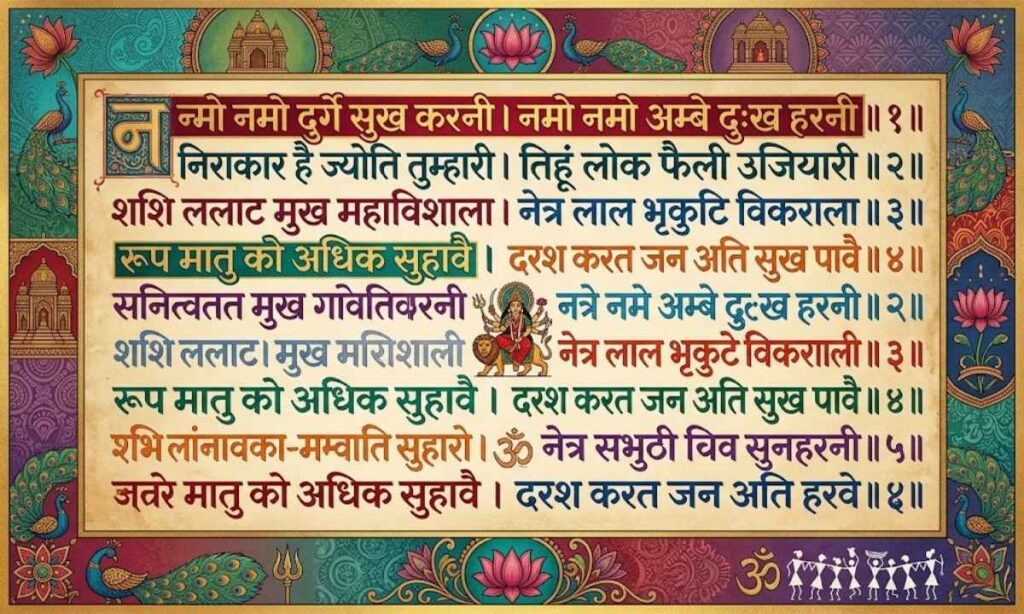
Below is the complete Durga Chalisa in Devanagari, arranged as 40 numbered verses. Each verse has two lines.
Complete Durga Chalisa in Devanagari
- नमो नमो दुर्गे सुख करनी। नमो नमो अम्बे दुख हरनी॥
- निराकार है ज्योति तुम्हारी। तिहूँ लोक फैली उजियारी॥
- शशि ललाट मुख महाविशाला। नेत्र लाल भृकुटि विकराला॥
- रूप मातु को अधिक सुहावे। दरश करत जन अति सुख पावे॥
- तुम संसार शक्ति लै कीना। पालन हेतु अन्न धन दीना॥
- अन्नपूर्णा हुई जग पाला। तुम ही आदि सुन्दरी बाला॥
- प्रलयकाल सब नाशन हारी। तुम गौरी शिवशंकर प्यारी॥
- शिव योगी तुम्हरे गुण गावें। ब्रह्मा विष्णु तुम्हें नित ध्यावें॥
- रूप सरस्वती को तुम धारा। दे सुबुद्धि ऋषि मुनिन उबारा॥
- धरयो रूप नरसिंह को अम्बा। परगट भई फाड़कर खम्बा॥
- रक्षा करि प्रह्लाद बचायो। हिरणाकुश को स्वर्ग पठायो॥
- लक्ष्मी रूप धरो जग माहीं। श्री नारायण अंग समाहीं॥
- क्षीरसिन्धु में करत विलासा। दयासिन्धु दीजै मन आसा॥
- हिंगलाज में तुम्हीं भवानी। महिमा अमित न जात बखानी॥
- मातंगी अरु धूमावति माता। भुवनेश्वरि बगला सुख दाता॥
- श्री भैरव तारा जग तारिणी। छिन्न भाल भव दुःख निवारिणी॥
- केहरि वाहन सोह भवानी। लांगुर वीर चलत अगवानी॥
- कर में खप्पर खड्ग विराजै। जाको देख काल डर भाजै॥
- सोहै अस्त्र और त्रिशूला। जाते उठत शत्रु हिय शूला॥
- नगरकोट में तुम्हीं विराजत। तिहुँलोक में डंका बाजत॥
- शुम्भ निशुम्भ दानव तुम मारे। रक्तबीज शंखन संहारे॥
- महिषासुर नृप अति अभिमानी। जेहि अघ भार मही अकुलानी॥
- रूप कराल कालिका धारा। सेन सहित तुम तिहि संहारा॥
- परी गाढ़ सन्तन पर जब जब। भई सहाय मातु तुम तब तब॥
- अमरपुरी अरु बासव लोका। तब महिमा सब रहें अशोका॥
- ज्वाला में है ज्योति तुम्हारी। तुम्हें सदा पूजें नर-नारी॥
- प्रेम भक्ति से जो यश गावें। दुःख दारिद्र निकट नहिं आवें॥
- ध्यावे तुम्हें जो नर मन लाई। जन्म-मरण ताकौ छुटि जाई॥
- जोगी सुर मुनि कहत पुकारी। योग न हो बिन शक्ति तुम्हारी॥
- शंकर आचारज तप कीनो। काम अरु क्रोध जीति सब लीनो॥
- निशिदिन ध्यान धरो शंकर को। काहु काल नहिं सुमिरो तुमको॥
- शक्ति रूप का मरम न पायो। शक्ति गई तब मन पछितायो॥
- शरणागत हुई कीर्ति बखानी। जय जय जय जगदम्ब भवानी॥
- भई प्रसन्न आदि जगदम्बा। दई शक्ति नहिं कीन विलम्बा॥
- मोको मातु कष्ट अति घेरो। तुम बिन कौन हरै दुःख मेरो॥
- आशा तृष्णा निपट सतावें। रिपू मुरख मौही डरपावे॥
- शत्रु नाश कीजै महारानी। सुमिरौं इकचित तुम्हें भवानी॥
- करो कृपा हे मातु दयाला। ऋद्धि-सिद्धि दै करहु निहाला॥
- जब लगि जिऊँ दया फल पाऊँ। तुम्हरो यश मैं सदा सुनाऊँ॥
- दुर्गा चालीसा जो कोई गावै। सब सुख भोग परमपद पावै॥
Opening Doha and Closing Prayer
The Chalisa begins directly with the praise of the goddess in verse 1, although some editions add a short invocation before it. It ends with a closing line naming Devidas, followed by a doha.
Closing line: देवीदास शरण निज जानी। करहु कृपा जगदम्ब भवानी॥
Closing doha: शरणागत रक्षा करे, भक्त रहे नि:शंक। मैं आया तेरी शरण में, मातु लीजिये अंक॥
How to Follow the Hindi Text During Paath
Read one verse at a time and pause briefly at each full stop mark. Keep a finger on the line if you are new to Devanagari. If a word feels hard, read the Roman version in the next section first and then return to Hindi. Printed editions can differ slightly in spelling and wording, so follow the version your family or temple uses.
Read more Kanaka Durga Temple: History, Significance, Timings, and Travel Guide.
Durga Chalisa in English (Roman Transliteration)
This section gives the same 40 verses in English letters, so beginners can read along without knowing Devanagari.
Complete Durga Chalisa in English Letters
- Namo namo Durge sukh karani, Namo namo Ambe dukh harani.
- Nirakar hai jyoti tumhari, Tihun lok phaili ujiyari.
- Shashi lalat mukh maha vishala, Netra lal bhrikuti vikarala.
- Roop matu ko adhik suhave, Darash karat jan ati sukh pave.
- Tum sansar shakti lai kina, Palan hetu anna dhan dina.
- Annapurna hui jag pala, Tum hi adi sundari bala.
- Pralaykal sab nashan hari, Tum Gauri Shivshankar pyari.
- Shiv yogi tumhre gun gaven, Brahma Vishnu tumhen nit dhyaven.
- Roop Saraswati ko tum dhara, De subuddhi rishi munin ubara.
- Dharyo roop Narsingh ko Amba, Pragat bhai phadkar khamba.
- Raksha kari Prahlad bachayo, Hiranyakush ko swarg pathayo.
- Lakshmi roop dharo jag mahin, Shri Narayan ang samahin.
- Kshirsindhu mein karat vilasa, Dayasindhu deejai man asa.
- Hinglaj mein tumhin Bhavani, Mahima amit na jat bakhani.
- Matangi aru Dhoomavati mata, Bhuvaneshwari Bagla sukh data.
- Shri Bhairav Tara jag tarini, Chhinna bhal bhav dukh nivarini.
- Kehari vahan soh Bhavani, Langur veer chalat agwani.
- Kar mein khappar khadg viraje, Jako dekh kal dar bhaje.
- Sohai astra aur trishula, Jate uthat shatru hiy shula.
- Nagarkot mein tumhin virajat, Tihun lok mein danka bajat.
- Shumbh Nishumbh danav tum mare, Raktabeej shankhan sanhare.
- Mahishasur nrip ati abhimani, Jehi agh bhar mahi akulani.
- Roop karal Kalika dhara, Sen sahit tum tihi sanhara.
- Pari gadh santan par jab jab, Bhai sahay matu tum tab tab.
- Amarpuri aru Basav loka, Tab mahima sab rahen ashoka.
- Jwala mein hai jyoti tumhari, Tumhen sada pujen nar-nari.
- Prem bhakti se jo yash gaven, Dukh daridra nikat nahin aven.
- Dhyave tumhen jo nar man lai, Janm-maran tako chhuti jai.
- Jogi sur muni kahat pukari, Yog na ho bin shakti tumhari.
- Shankar acharaj tap keeno, Kam aru krodh jeeti sab leeno.
- Nishidin dhyan dharo Shankar ko, Kahu kal nahin sumiro tumko.
- Shakti roop ka maram na payo, Shakti gai tab man pachhitayo.
- Sharanagat hui kirti bakhani, Jai jai jai Jagdamb Bhavani.
- Bhai prasann adi Jagdamba, Dai shakti nahin keen vilamba.
- Moko matu kasht ati ghero, Tum bin kaun harai dukh mero.
- Asha trishna nipat satavein, Ripu murakh mauhi darpave.
- Shatru nash keejai Maharani, Sumiron ikchit tumhen Bhavani.
- Karo kripa he matu dayala, Riddhi-siddhi dai karahu nihala.
- Jab lagi jiyun daya phal paun, Tumhro yash main sada sunaun.
- Durga Chalisa jo koi gave, Sab sukh bhog parampad pave.
Closing line: Devidas sharan nij jani, Karahu kripa Jagdamb Bhavani.
Closing doha: Sharanagat raksha kare, Bhakt rahe nishank. Main aaya teri sharan mein, Matu lijiye ank.
Easy Pronunciation for Beginners
Say the vowels softly: “a” is like the “u” in “but,” “aa” is a long sound like “father,” and “ee” sounds like “see.” Words ending in “a” are often shorter in speech, so Durga sounds like “Dur-ga.” Listening to a trusted recording first can help you copy the rhythm.
Tips for Reading the Verses Correctly
Read slowly and in a steady rhythm. Keep each verse together as a single unit, and do not rush the end of each line. If the spelling in your edition differs from this one, that is normal, since Roman spelling is not fixed for Hindi words.
Durga Chalisa Meaning in English
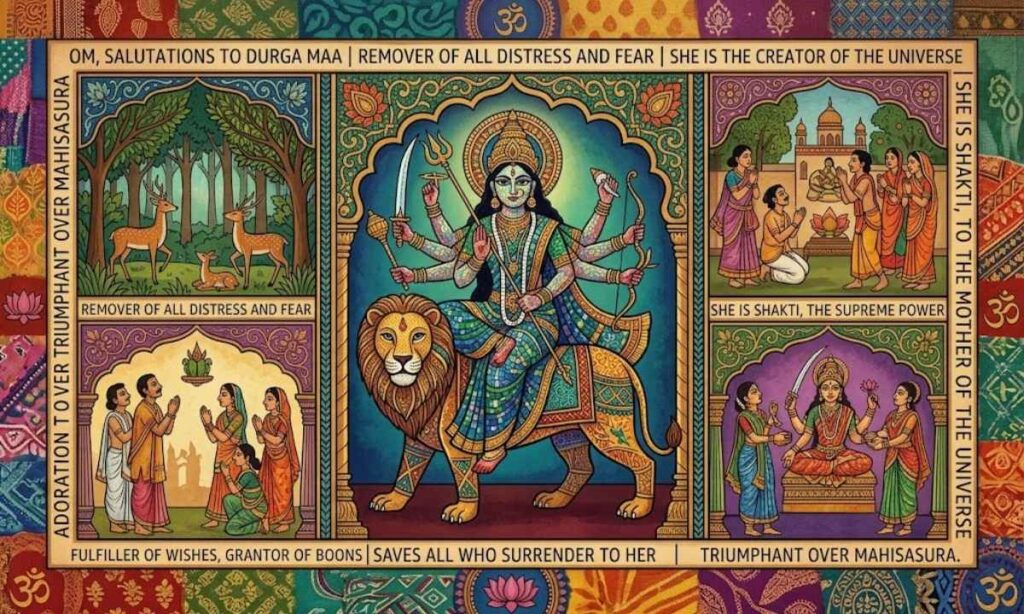
The table below gives the meaning of each verse in simple English. These are plain explanations, and translators may word some lines differently.
| Verse | Meaning in English |
| 1 | Salutations to Durga, giver of happiness, and to Amba, remover of sorrow. |
| 2 | Your light is formless, and its glow spreads across the three worlds. |
| 3 | Your forehead shines like the moon, your face is broad, and your eyes are red under fierce brows. |
| 4 | Mother, your form is beautiful, and those who see you feel great joy. |
| 5 | You created the energy of the world and gave food and wealth to sustain it. |
| 6 | As Annapurna you nourish the world, and you are the first, ever-youthful beauty. |
| 7 | You bring about the end of the world at its time, and you are Gauri, beloved of Shiva. |
| 8 | Shiva and the yogis sing your praises, and Brahma and Vishnu meditate on you always. |
| 9 | You took the form of Saraswati, gave wisdom, and rescued the sages. |
| 10 | O Amba, the hymn says you took the Narasimha form and appeared by splitting a pillar. |
| 11 | You protected Prahlad and sent Hiranyakashipu to heaven. |
| 12 | You took the form of Lakshmi in the world and rest beside Lord Narayan. |
| 13 | You dwell in the ocean of milk; O ocean of mercy, fulfill the hopes of my heart. |
| 14 | At Hinglaj you are Bhavani, and your glory is beyond words. |
| 15 | You are Matangi, Dhumavati, Bhuvaneshwari, and Bagala, givers of happiness. |
| 16 | You are also Bhairavi, Tara, and Chhinnamasta, who remove the sorrows of worldly life. |
| 17 | The lion is your mount, and brave Langur leads the way before you. |
| 18 | A skull-bowl and sword shine in your hands, and seeing them, death itself runs away. |
| 19 | Your weapons and trident are splendid, and they pain the hearts of enemies. |
| 20 | You dwell at Nagarkot, and your fame resounds in all three worlds. |
| 21 | You destroyed the demons Shumbh and Nishumbh, along with Raktabeej and Shankhan. |
| 22 | King Mahishasura was very proud, and the burden of his sins troubled the earth. |
| 23 | You took the fierce form of Kali and destroyed him along with his army. |
| 24 | Whenever saints faced hardship, you came to their help, Mother. |
| 25 | In heavenly realms and other worlds, people stay free from sorrow through your glory. |
| 26 | Your light shines in the sacred flame, and men and women always worship you. |
| 27 | Those who sing your praise with loving devotion are not touched by sorrow or poverty. |
| 28 | Those who meditate on you wholeheartedly are said to be freed from the cycle of birth and death. |
| 29 | Yogis, gods, and sages declare that yoga is not possible without your power. |
| 30 | The hymn says Shankaracharya performed austerity and conquered desire and anger. |
| 31 | He meditated on Shankar day and night but did not remember you at any time. |
| 32 | He did not understand the secret of Shakti, and when his strength left, he regretted it. |
| 33 | He took refuge in you and praised your fame: Victory, victory to the Mother of the World. |
| 34 | You were pleased, and you gave him power without delay. |
| 35 | Mother, troubles surround me; who but you can remove my sorrow? |
| 36 | Hope and craving torment me, and foolish enemies frighten me. |
| 37 | O Queen, destroy my enemies; I remember you with a single mind. |
| 38 | Be kind, merciful Mother, and bless me with prosperity and success. |
| 39 | As long as I live, may I receive your grace and always sing your glory. |
| 40 | Whoever sings the Durga Chalisa is believed to enjoy happiness and attain the highest state. |
| Closing line | Devidas, knowing his refuge, prays: show mercy, Mother of the World. |
| Closing doha | One who takes refuge is protected and stays fearless; I have come to your shelter, Mother, take me into your lap. |
Meaning of the Opening Verses
Verses 1 to 4 praise Maa Durga as the giver of happiness and the remover of sorrow. They describe her light as formless and present in all the worlds, and they describe her beautiful yet powerful appearance.
Maa Durga’s Divine Forms and Powers
Verses 5 to 20 describe the many forms of the goddess. She is Annapurna who feeds the world, Gauri beloved of Shiva, Saraswati who gives wisdom, and Lakshmi who gives prosperity. They also name powerful forms such as Matangi, Dhumavati, and Bhuvaneshwari, and describe her lion, her weapons, and her temples.
The Story of Maa Durga’s Victory Over Evil
Verses 21 to 25 recall her victories over the demons Shumbh, Nishumbh, Raktabeej, and Mahishasura. These verses are the heart of the hymn’s message that good ultimately overcomes evil, and that the goddess comes to the aid of her devotees in difficult times.
Meaning of the Final Verses and Prayer
Verses 26 to 40 move from praise to personal prayer. They say that those who worship with love are free from sorrow, recall a story about Shankaracharya learning the importance of Shakti, and then the devotee asks for protection, strength, and prosperity. The closing line and doha repeat the idea of complete surrender and trust.
Main Spiritual Message of Durga Chalisa
The main message is that divine power, called Shakti, is the source of all strength, and that sincere devotion brings the mother’s care. It teaches humility, courage, and reliance on faith during hard times.
Benefits of Reading Durga Chalisa
The benefits described below are traditional religious beliefs and personal experiences of devotees. They are not guaranteed results.
Seeking Maa Durga’s Blessings and Protection
Devotees read the Chalisa to ask for the goddess’s blessings and protection for themselves and their families. Readers from other faith traditions who also look for protective prayers may read these warfare prayer points with scriptures.
Finding Courage and Inner Strength
The hymn tells stories of the goddess defeating powerful demons, which many people find encouraging during difficult times. Those who are working to overcome unhealthy habits often look for spiritual support too, and some may find these pornography prayer points helpful alongside their own faith practice.
Supporting Peace of Mind Through Prayer
Reading the Chalisa slowly in a quiet space can help many people feel calm and focused. Students who feel stressed before tests may also find encouragement in exam success wishes and prayers.
Strengthening Faith and Devotion
Regular recitation builds a habit of daily prayer and gratitude. Over time, the verses become familiar and many devotees feel a deeper connection with the goddess.
Spiritual Significance of Regular Recitation
In the Hindu tradition, regular recitation is seen as a form of worship that purifies the mind and strengthens devotion. People of other faiths also value steady prayer, and readers may explore these pornography prayer points with scriptures as another example of focused spiritual discipline.
How to Recite Durga Chalisa at Home
Follow these simple steps if you are new to the practice. Families may add or change steps based on their own tradition.
Step 1: Choose a Clean and Peaceful Place
Select a quiet spot in your home where you will not be disturbed. Wash your hands and wear clean clothes.
Step 2: Prepare the Puja Area
Place an image or idol of Maa Durga on a clean cloth. Keep flowers, incense, and a diya nearby, and arrange a small plate for prasad if you wish.
Step 3: Begin With a Prayer to Maa Durga
Light the diya and bow with folded hands. Offer a short prayer in your own words, asking for her blessings before you begin.
Step 4: Read the Chalisa Slowly and Clearly
Read each verse calmly, in Hindi or Roman letters, whichever is comfortable. Do not rush, and keep your attention on the words.
Step 5: Reflect on the Meaning of the Verses
After reading, think about what the verses mean, or read the English meaning from the table above. Understanding the words makes the prayer more heartfelt.
Step 6: Conclude With a Personal Prayer or Aarti
End with the closing doha, a short personal prayer, or the Durga Aarti. Share prasad with the family and thank the goddess for her blessings.
Best Time to Read Durga Chalisa
There is no single required time. Choose a time when you can sit calmly and focus.
Durga Chalisa in the Morning
Many devotees read the Chalisa in the morning after a bath, when the mind is fresh and the home is quiet. Starting the day with prayer sets a peaceful tone, and some people also add a good morning prayer for my love to bless their loved ones.
Reciting Durga Chalisa in the Evening
Evening is another popular time, often along with the lighting of the diya at sunset. It can be a calming way to end a busy day.
Reading Durga Chalisa During Navratri
Navratri is the most popular period for reading the Chalisa, and many families read it every day during the nine nights. Fridays and Tuesdays are also considered special for Devi worship in many homes.
Is There a Fixed Day or Time for Recitation?
No, there is no strict rule, and you can read it on any day. Some people like to begin each week with prayer, and a new week prayer for my love can be a gentle companion to that habit.
How Many Times Should You Read Durga Chalisa?
The number of recitations depends on your time, health, and family tradition. Sincerity matters more than the count.
Reciting Durga Chalisa Once Daily
Reading it once a day is the simplest and most common practice. It takes about ten to fifteen minutes at a relaxed pace.
Repeated Recitation During Navratri
Some devotees read it more than once a day during Navratri, or gather with family and neighbors to recite it together. Group prayer is common in many faiths, and readers can see this spirit in these prayer points for church growth.
Following Your Family’s Devotional Tradition
Families and regions follow different customs, so it is best to follow the practice you were taught. Devotional traditions around the world also vary widely, as with Santa Muerte prayer in English, which belongs to a very different tradition. Respect for each path is part of a mature faith.Learn about Durga Maa Puja rituals, mantras, and spiritual significance.
Durga Chalisa vs. Durga Aarti and Durga Saptashati
These three are often mentioned together, but they are different texts and practices.
| Feature | Durga Chalisa | Durga Aarti | Durga Saptashati |
| Type | Devotional hymn | Devotional song or prayer performed during aarti | Longer sacred text |
| Main purpose | Praise Maa Durga | Express devotion through worship and singing | Narrate the Goddess’s glory and victories |
| Length | 40 principal verses | Depends on the aarti | A traditional text of 700 verses |
| Common use | Daily worship and Navratri | Often performed during puja | Special worship, including Navratri |
Difference Between Durga Chalisa and Durga Aarti
The Chalisa is a hymn of 40 verses that you can read or sing at any time. The aarti is a shorter song sung while waving a lamp before the deity, usually at the end of puja.
Difference Between Durga Chalisa and Durga Saptashati
The Durga Saptashati, also called the Devi Mahatmya, is a much longer scripture of 700 verses that tells the stories of the goddess in detail. The Chalisa is a short, simple devotional hymn that is easier for daily use.
Which Prayer Should Beginners Start With?
Beginners usually start with the Durga Chalisa and the aarti, since both are short and easy to learn. The Saptashati can be added later with guidance from a priest or an experienced devotee.
Frequently Asked Questions
How many verses are in Durga Chalisa?
The Durga Chalisa has 40 principal verses. Most editions also add a closing line and a short doha.
Can I read Durga Chalisa every day?
Yes, many devotees read it daily as part of their worship. A single calm recitation is enough.
What is the best time to read Durga Chalisa?
Morning, evening, and Navratri are popular times, but there is no strict rule. Choose a time when you can sit quietly.
Can beginners read Durga Chalisa in English?
Yes, beginners can read the Roman version and the English meaning. Over time, you can learn the Hindi text.
Can Durga Chalisa be read without a diya?
Yes, the Chalisa can be read anywhere, even without a diya. A lamp and flowers are traditional, but sincerity matters most.
How long does it take to recite Durga Chalisa?
It usually takes about ten to fifteen minutes at a calm pace. Singing it with music may take a little longer.
Is Durga Chalisa especially important during Navratri?
Yes, many families read it daily during Navratri as part of their worship. It is considered an easy and meaningful offering.
Who is traditionally credited with writing Durga Chalisa?
The hymn is traditionally credited to Devidas, whose name appears in the closing verse. Reliable historical details are limited.
Conclusion
The Durga Chalisa is a short and heartfelt hymn that praises Maa Durga as the source of strength, protection, and compassion. By reading the Hindi lyrics, the Roman version, and the English meaning, you can connect with the verses more deeply. Take your time, understand what you recite, and follow your family tradition with respect. May your prayer be sincere, and may your faith and devotion to Maa Durga grow stronger each day.